Ernest Jones:
Master of the Golf Swing
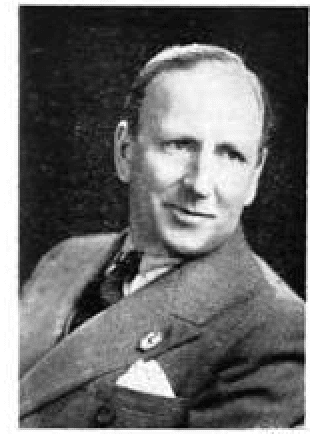
Ernest Jones (October 25, 1887 – July 1965) was an English professional golfer who became one of the most renowned and influential golf instructors of the 20th century. He is celebrated for teaching a vast array of famous professional and amateur golfers alike. Most notably, Jones tutored Virginia Van Wie for many years—guiding her through a dominant stretch of three consecutive U.S. Women's Amateur championships from 1932 to 1934. His star-studded roster of students also included Glenna Collett Vare, Lawson Little, Betty Hicks, Phil Farley, George Schniter, and Horton Smith.
Early Life and Military Service
Jones was born near Manchester, England. He developed a passion for golf as a young boy, winning a local caddie championship at just 12 years old. By age 18, he secured employment as an assistant professional at Chislehurst Golf Club, rising to the position of head professional by 1913 when he was 25.
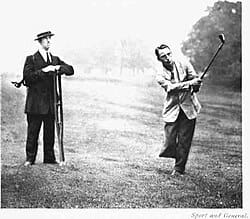
With the outbreak of the First World War, Jones joined the army in 1914 and was deployed to France. In March 1916, while serving near Loos with the Sportsman's Battalion of the Royal Fusiliers, an exploding grenade severely injured him, resulting in the amputation of his right leg just below the knee. Fearing this devastating injury would effectively end his career as a professional golfer, Jones returned to England to recuperate.
Four months into his recovery, still relying on crutches, he attempted his first post-injury round of golf at Royal Norwich. Remarkably, he carded an 83 on his first outing, followed shortly after by an outstanding 72 on a long, challenging course. While these rounds offered immense relief regarding his future in the sport, they also served as the catalyst for a radical change in how he perceived the mechanics of the golf swing. He was later fitted with a prosthetic leg and continued his life in golf.
Move to America and New York Teaching Career
In 1923, at the invitation of Marion Hollins, Jones moved his family—including his wife Rosina and daughter Patricia—to Oyster Bay, New York. He accepted the prestigious position of Head Golf Professional at the Women's National Golf and Tennis Club in Long Island. This move marked the beginning of a highly successful, lifelong teaching career in the United States.
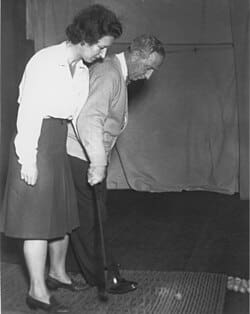
Following his tenure at the club, Jones moved his operations into New York City, establishing an indoor teaching facility on the 7th floor of the A.G. Spalding & Bros. store at 518 Fifth Avenue in Manhattan. Operating from 9:30 AM until he had to catch the 6:08 PM commuter train home to Glen Head, Long Island, Jones became an absolute phenomenon. He booked nearly 3,000 lessons per year at what was then a premium price of $5 per lesson—a volume unmatched by contemporary instructors, who often charged much more for half the student output.
Jones preferred the indoor setting because it eliminated the visual distraction of the ball's flight. This forced students to hone the execution of the swing itself, specifically focusing on generating the proper centrifugal force needed to propel the ball. To teach this sensation, Jones famously utilized a unique training aid: a penknife suspended from the end of two knotted handkerchiefs.
Instructional Philosophy:
"Swing the Clubhead"
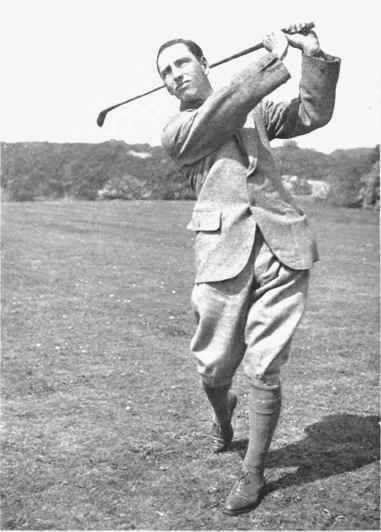
Jones' instructional philosophy was born directly from his experience as an amputee. He questioned how he could score so effectively despite losing a limb, while mainstream golf theory insisted that specific, complex body movements were essential. Drawing inspiration from Sir Walter Simpson's book The Art of Golf, Jones concluded that the key to a successful golf shot was not the conscious movement of body parts, but rather the correct movement of the clubhead itself.
Jones recognized that the human brain operates unconsciously to execute a physical task once a desire is established; the golfer only needs to know what they want to do, and the subconscious brain figures out how to coordinate the muscles to achieve it.
This breakthrough inspired his lifelong quest to share a club-focused approach to the game, summarized by his timeless mantra: "Swing the Clubhead." He authored numerous articles and published two definitive books on the subject to spread his findings.
Resistance from the PGA
The radical simplicity of Jones' system did not sit well with the traditional golfing establishment. When invited by the Professional Golfers' Association of America (PGA) to present his methods, he met with intense pushback. Horton Smith, the incoming president of the association at the time, openly objected, telling Jones that his system was "too simple. We wouldn't sell enough lessons."
Jones famously fired back:
"That's the trouble, you want your students to keep on suffering. Once you get your people to swing the clubhead they will improve."
Despite the friction, Jones' methods thrived. One of his most dedicated disciples was Angel de la Torre, who passed the philosophy down to his son, Manuel de la Torre. Manuel became the preeminent authority on Jones' work, further developing the system and introducing thousands of additional golfers to the club-focused approach. Jones frequently summarized the flaw of modern coaching by stating:
"The trouble with the teaching of golf is that one is taught what a swing produces [body movement], instead of how to produce a swing [club movement]."
Legacy and Honors
Jones passed away in July 1965. Over the course of his multi-faceted career, he played competitively on the European tour, won a number of tournaments, managed esteemed American golf clubs, and transformed golf instruction for both touring pros and weekend amateurs.
In the year of his death, he was honored with the Ben Hogan Award. In recognition of his enduring impact on the game, Ernest Jones was posthumously inducted into the World Golf Teachers Hall of Fame in 1977, alongside iconic peers Harvey Penick, Tommy Armour, and Percy Boomer.